A clinician applies
An Alberta physician or dentist must apply for an eligible patient. Patients cannot self-refer or submit the application documents themselves.
Care Beyond Canada brings patient and family voices together as Alberta reviews how it funds medically necessary care that cannot reasonably be provided in Canada.
OUR MISSION
The Government of Alberta has committed to reviewing its Out-of-Country Health Services program, recognizing that the policies guiding it are outdated and may no longer meet the needs of patients today. Our family experienced firsthand the devastating impact the current policies can have when medically necessary care is not available at home. Since sharing our story, we have heard from many others across Alberta and Canada facing similar barriers.
Our mission is to bring our voices together to ensure patients and families are heard throughout the review, and to advocate for transparent, fair and medically appropriate change in Alberta. We hope this work will also inspire broader policy reform across Canada.
THE CURRENT SYSTEM
This plain-language overview is based on Alberta’s official program page. It is general information—not medical or legal advice—and program requirements can change.
An Alberta physician or dentist must apply for an eligible patient. Patients cannot self-refer or submit the application documents themselves.
The service must be medically necessary, insured, supported by clinical documentation, unavailable in Canada after appropriate options are exhausted, and neither experimental nor part of a trial.
The committee says each complete application is assessed on its own evidence and circumstances within current legislation.
The separate Appeal Panel reviews the original record and appeal. Alberta says the panel is not authorized to review new information.
Alberta’s published process sets business-day periods for decisions, notices and appeals. For a live case, confirm the current dates and requirements directly with the program.
THE ALBERTA REVIEW
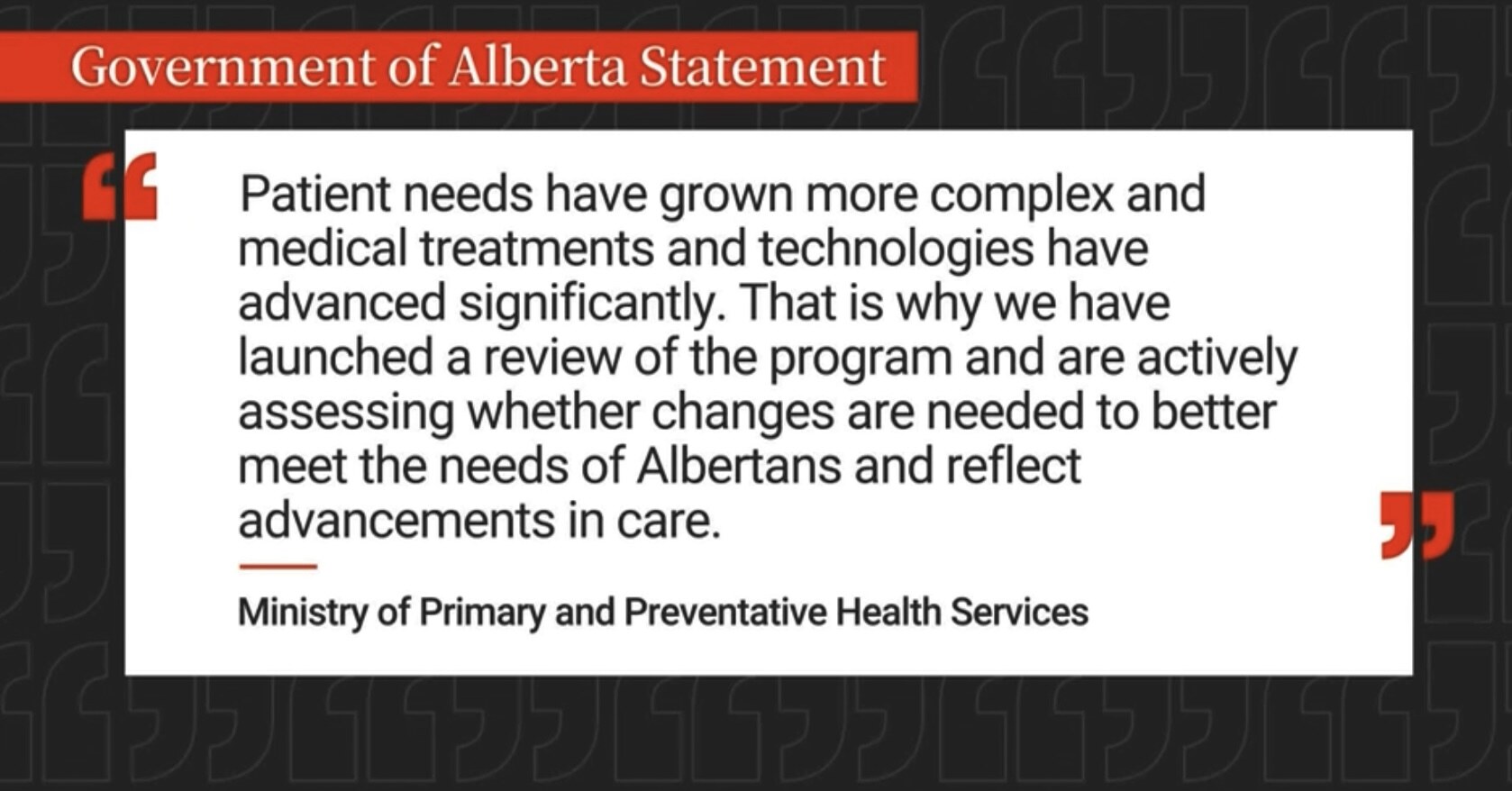
Alberta’s Ministry of Primary and Preventative Health Services told Global News that it had launched a review of the program and was assessing whether changes are needed.
The ministry has publicly acknowledged that patient needs and medical care have evolved and that the program is under review.
The review’s full scope, completion schedule, and formal process for patient and family participation.
Last reviewed: September 2, 2026. This section will be updated when attributable information is available.
WHAT NEEDS TO CHANGE
Our goal is to help ensure Alberta’s Out-of-Country Health Services program provides a fair, transparent and medically appropriate pathway for patients who require necessary care that cannot reasonably be provided in Canada. We want to work alongside government and encourage a review that strengthens the program so decisions are based on patient need, appropriate medical expertise, clear evidence and timely access to care.
Medical necessity, the patient’s individual circumstances, and the consequences of delay should sit at the centre of every decision.
Rare and complex cases should be reviewed by specialists with relevant expertise. Where that expertise is unavailable within the program, substantial weight should be given to applying and treating physicians.
Established care that is unavailable in Canada should not be treated the same as experimental care. Evidence standards should clearly recognize appropriate Canadian and international medical evidence.
Applications and appeals should be decided before scheduled treatment dates, with an expedited process for urgent cases.
A denial should identify a clear, medically appropriate and actually accessible option in Canada—not a theoretical service that the patient cannot reasonably receive.
PATIENT & FAMILY STORIES
Use the route that matches your comfort level. Public stories are moderated, and a pseudonym is welcome. Private messages stay in the contact queue.
Create a private draft, choose a public display name, add photographs only with separate consent, and submit it for moderation.
Start a storyShare an experience privately or ask a question without submitting it for public publication.
Send a private messageAsk about speaking with media or participating in future advocacy. Nothing is promised or published through this contact step.
Contact the movementTAKE ACTION
Every action below goes to a real destination. Choose the one that fits you.
MEDIA & OFFICIAL RESOURCES
Coverage about this movement is separated from related reporting. Official program rules remain clearly identified as government information.